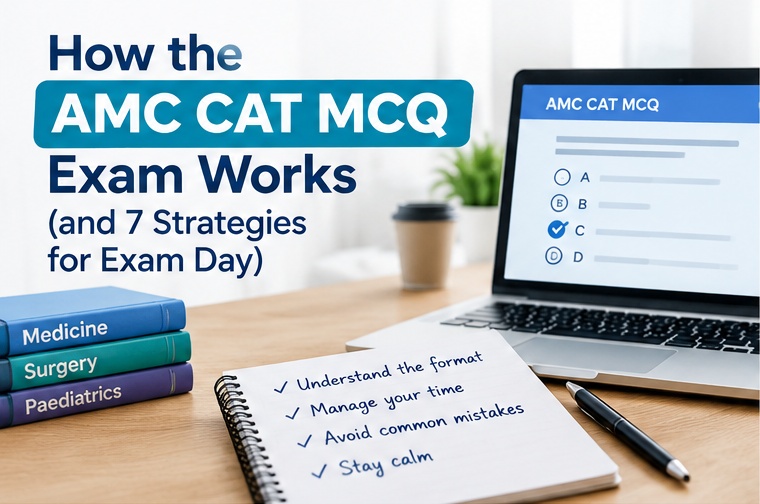
The Australian Medical Council MCQ examination is a computer adaptive test (CAT). That single fact changes how the exam feels and how you should approach it. Understanding how it works will help you stay calm, manage your time and avoid costly mistakes on exam day.
What “computer adaptive” means
In a fixed exam, everyone answers the same questions. In a computer adaptive test, the computer picks each question based on how you are doing. A correct answer usually leads to a harder question, and an incorrect answer usually leads to an easier one. Over 150 questions, the exam homes in on the level of difficulty you can answer reliably. That ability estimate becomes your score.
The AMC reports scores on a scale from 0 to 500, and 250 is the pass mark. Because the exam measures ability rather than counting correct answers, two candidates can answer the same number of questions correctly and still receive different scores, depending on how difficult their questions were.
The rules that matter
- 150 single-best-answer questions, each with five options (A to E).
- 3.5 hours in total, which is about 84 seconds per question.
- You must answer every question.
- You cannot go back to review or change an answer.
- There is no negative marking.
- Some questions are new items being calibrated, and you cannot tell which ones.
7 strategies for the AMC CAT MCQ
1. Expect it to feel hard, and don’t panic
If you are doing well, the test will keep giving you harder questions. Many candidates who pass leave the exam feeling they did badly. A run of difficult questions is often a good sign, so do not let it shake your confidence.
2. Read the question line first
Before reading a long stem, look at the actual question: “most likely diagnosis”, “most appropriate next step” or “most useful investigation”. Then read the stem with that task in mind. This saves time and keeps you focused on the details that matter.
3. Treat every question as final
You cannot flag a question and return to it. Give each one your full attention, make the best decision you can and move on. Second-guessing the previous question while reading the next one costs you marks on both.
4. Never leave a question unanswered
There is no negative marking. If you are unsure, eliminate the options you know are wrong and choose the best of the rest. An educated guess is always better than running out of time.
5. Watch the clock at checkpoints
Divide the exam into checkpoints: about 50 questions by 70 minutes, 100 by 140 minutes and 150 by 210 minutes. If you are behind at a checkpoint, speed up a little on the next few questions instead of rushing at the very end.
6. Think “safe Australian junior doctor”
When two answers look reasonable, choose the one a safe junior doctor in Australia would do first. That usually means treating life threats before investigating, following Australian guidelines and escalating appropriately. AMC questions reward safe, guideline-based decisions.
7. Look after the basics
Check your Pearson VUE confirmation, identification requirements and test centre location well before the day. Sleep properly the night before, eat beforehand and use any scheduled breaks to rest your eyes. A clear head is worth more than last-minute cramming.
How to practise for an adaptive exam
The best preparation is a large set of exam-style questions with high-quality explanations, practised first by subject and then in timed mixed blocks. Read every explanation, keep an error log and re-attempt questions you got wrong. Our 12-week AMC MCQ study plan shows how to structure this, and the AMC MCQ exam guide covers the format and blueprint in detail.
AMC Question Bank is independent and not affiliated with the Australian Medical Council. Always check the AMC and Pearson VUE websites for current exam-day rules.