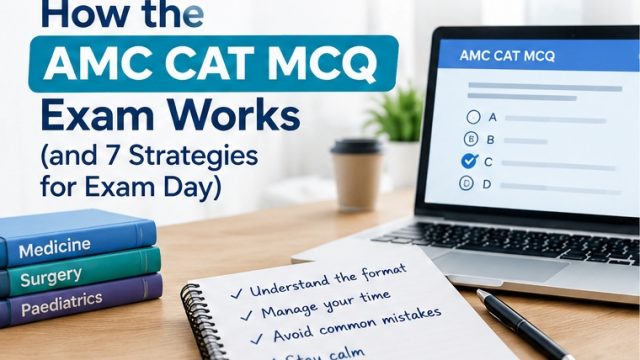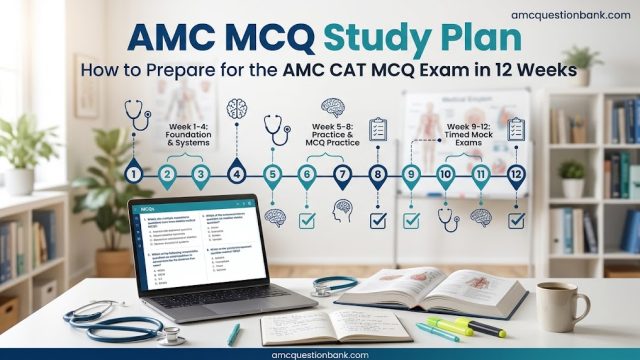
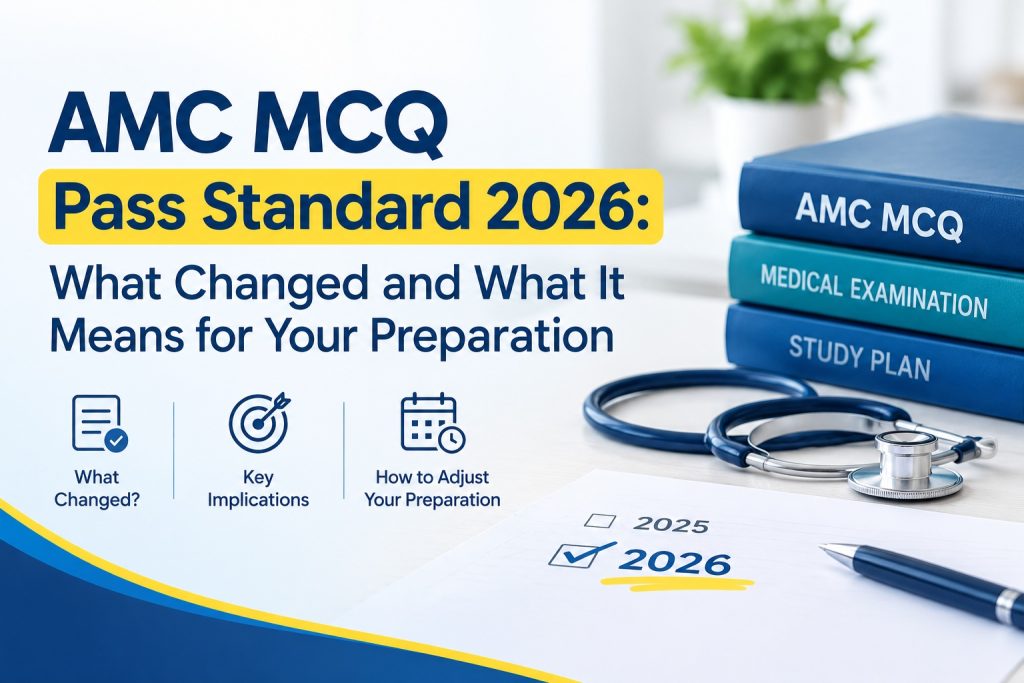
If you are preparing for the Australian Medical Council CAT MCQ examination, you may have heard that the pass mark changed in 2026. The real picture is more nuanced, and it matters for how you prepare. Here is what changed, what stayed the same and what you should do about it.
The short version
- The exam format is unchanged: 150 questions in 3.5 hours, computer adaptive.
- Scores are still reported on a 0–500 scale, and 250 is still the pass mark.
- The AMC slightly raised the underlying standard, which is the level of ability needed to reach 250.
- The change applies to sittings from 2026. Earlier results are not reassessed.
What is a “pass standard” in a computer adaptive test?
In a traditional exam, the pass mark is usually a percentage of questions answered correctly. The AMC CAT MCQ does not work like that. Because it is a computer adaptive test, each candidate sees a different set of questions, chosen according to how they are performing. Harder questions follow correct answers, and easier questions follow incorrect ones.
To make results fair across candidates who saw different questions, the AMC uses item response theory to estimate each candidate’s ability. That estimate is then converted to a reported score between 0 and 500. The pass standard is the ability level, set by expert standard-setting, that converts to a reported score of 250.
What changed for 2026?
After its routine standard-setting review, carried out with representatives from Australian medical schools, the AMC decided that the ability level needed to pass should be slightly higher. From 2026, a candidate needs to show a slightly higher level of ability to reach the reported score of 250.
Nothing else about the exam changed. The number of questions, the timing, the blueprint, the question type and the reporting scale are all the same. Because the score reflects ability rather than a percentage of correct answers, it is not meaningful to say you need a fixed number of extra correct answers to pass.
Who is affected?
The new standard applies to candidates who sit the exam in 2026 or later. Results from earlier sittings were assessed against the standard in force at the time and are not re-marked.
What should you do differently?
1. Aim for a margin, not the line
Candidates who were scoring just above the pass line in practice now have less room for error. Plan your preparation so you are comfortably above the standard in every discipline, not just on average.
2. Fix your weakest discipline first
Four of the six patient groups each carry 12.5% of the exam. A weak result in obstetrics, paediatrics, psychiatry or population health and ethics can pull an otherwise solid score down. Use subject-based practice to find your weakest area early, then give it extra time.
3. Practise at exam difficulty
An adaptive exam pushes stronger candidates towards harder questions. Practise with questions that make you think about the most appropriate answer among several plausible options, and read every explanation, including for the questions you get right.
4. Build pace and stamina
You must answer all 150 questions and you cannot go back. Practise timed mixed blocks at about 84 seconds per question in the final weeks, so pacing never costs you marks.
The bottom line
The 2026 change is a small rise in the bar, not a new exam. Candidates who prepare broadly, practise with exam-style questions and learn from detailed explanations are in the strongest position. For a full overview of the exam, read our AMC MCQ exam guide.
AMC Question Bank is independent and not affiliated with the Australian Medical Council. Always check the AMC website for official, current information.