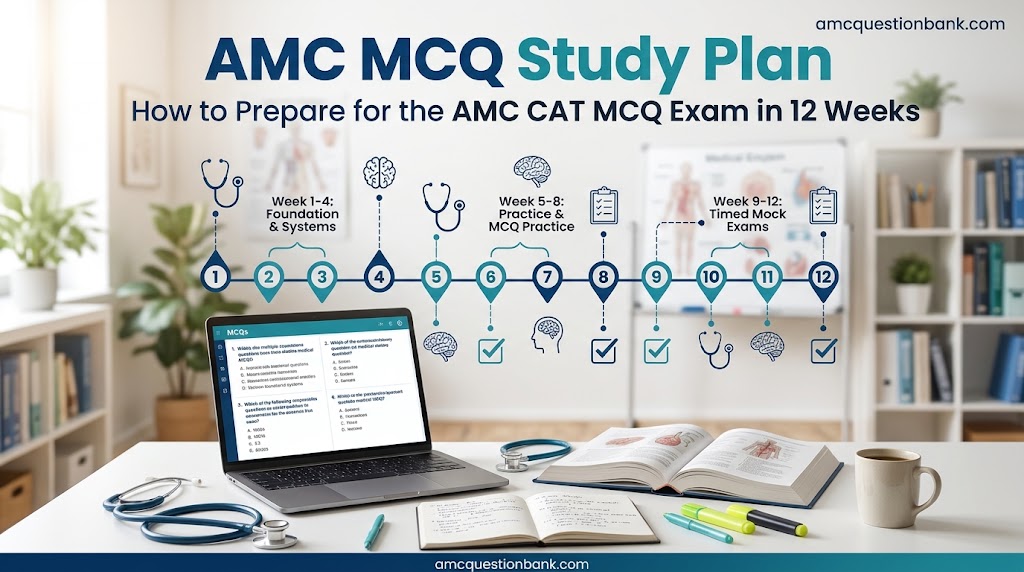
Most international medical graduates prepare for the AMC CAT MCQ exam while working, raising a family or both. A clear plan matters more than total hours. This 12-week study plan is built around the AMC blueprint and the way the exam actually tests you, and it is realistic for someone studying around 15 to 20 hours a week.
Plan at a glance
- Weeks 1–4: Adult Medicine and Surgery (50% of the exam)
- Weeks 5–8: O&G, Paediatrics, Psychiatry, Population Health & Ethics
- Weeks 9–11: timed mixed blocks and error review
- Week 12: consolidation and rest
Before you start: take a baseline
Spend your first session on a mixed set of questions from every discipline. Our free 25-question trial works well for this. Do not worry about the score. The aim is to find out which areas feel unfamiliar. Many experienced doctors find that obstetrics, paediatrics, psychiatry and Australian ethics and law are their weakest areas, simply because they have not practised them for years.
The daily routine
On a typical weekday, aim for one focused block:
- Questions (45–60 minutes): 30–40 questions on the week’s topic.
- Explanations (45–60 minutes): read the explanation for every question, including the ones you got right. Ask why the best answer beats the second-best option.
- Error log (10 minutes): write one line for each topic you missed. This list becomes your revision plan for the final month.
At weekends, do a longer block and revisit the week’s error log.
Weeks 1–4: Adult Medicine and Surgery
Together, Adult Medicine (30%) and Surgery (20%) make up half the exam, so start here.
- Week 1: cardiology, respiratory and emergencies such as ACS, PE, sepsis and anaphylaxis.
- Week 2: endocrinology, renal and electrolytes, gastroenterology and hepatology.
- Week 3: neurology, infectious diseases, haematology, rheumatology and dermatology.
- Week 4: surgery, covering the acute abdomen, trauma, vascular, urology, orthopaedics and peri-operative care.
Work untimed in this phase. You are building understanding, not speed.
Weeks 5–8: the four 12.5% disciplines
Each of these carries as many marks as the others, so give each one a full week.
- Week 5: Obstetrics & Gynaecology. Focus on antenatal schedules, obstetric emergencies, contraception and cervical screening.
- Week 6: Paediatrics. Focus on the febrile child, respiratory illness, developmental milestones and the immunisation schedule.
- Week 7: Psychiatry. Focus on mood and psychotic disorders, risk assessment and psychopharmacology emergencies.
- Week 8: Population Health & Ethics. Focus on biostatistics, screening programs, consent, confidentiality and fitness to drive.
Population health and ethics is a small syllabus with a high return. A week of focused practice here can lift your overall score noticeably.
Weeks 9–11: exam conditions
Now switch to timed, mixed-subject blocks. The real exam gives you 3.5 hours for 150 questions, which is about 84 seconds per question. Train yourself to read the last line of the stem first, identify what is being asked, and commit to an answer. You cannot go back in the real exam, so practise making a decision and moving on.
- Do at least three blocks of 50 timed mixed questions each week.
- Re-attempt every question you got wrong in weeks 1–8.
- Track your scores by discipline. If one subject lags, give it an extra session.
Week 12: consolidate and rest
Go through your error log one last time and revise the high-yield emergencies and guidelines. Take one full-length timed session early in the week, then ease off. Arrive on exam day rested. Fatigue costs more marks than one more night of revision gains.
Common mistakes to avoid
- Only studying your own specialty. The exam samples all six disciplines.
- Doing questions without reading explanations. The explanations are where the learning happens.
- Using non-Australian guidelines. Management answers reflect Australian practice.
- Leaving timed practice too late. Pace is a skill that needs weeks to build.
How much time do you need?
Twelve weeks works for most candidates who can study consistently. If you have been away from general clinical practice for a long time, or can only study a few hours a week, stretch the plan to 16–20 weeks and keep the same order.
Read our AMC MCQ exam guide for full details of the exam format and scoring.